

Introduction
Cyber threats are no longer rare, isolated incidents as they are constant, evolving, and increasingly sophisticated. From ransomware attacks to insider threats, businesses today face a reality where data compromise is not a question of if, but when.
This is why organizations are shifting from traditional data protection models to a more advanced and strategic approach: cyber resiliency.
If your current strategy relies solely on backups, your business may be at significant risk.
What Is Cyber Resiliency?
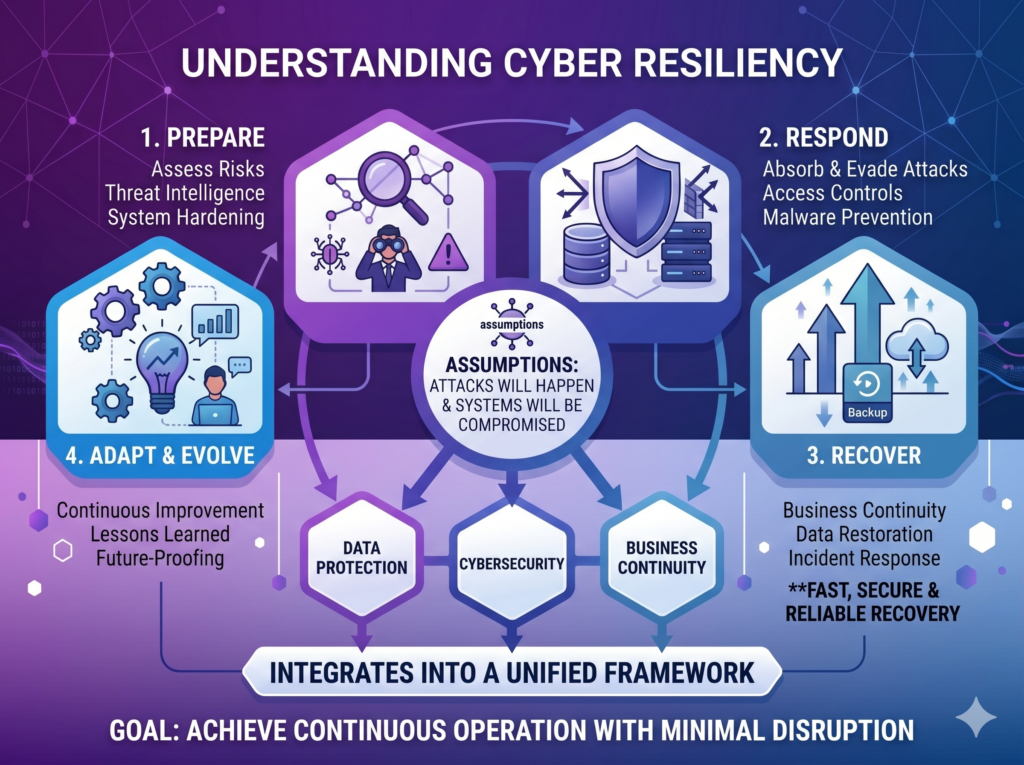
Cyber resiliency is the ability of an organization to prepare for, respond to, and recover from cyberattacks while continuing business operations with minimal disruption.
Unlike traditional disaster recovery, cyber resiliency assumes:
- Attacks will happen
- Systems will be compromised
- Recovery must be fast, secure and reliable
It integrates data protection, cybersecurity, and business continuity into a unified framework.
Why Traditional Backup Strategies Are No Longer Enough
Many organizations still rely on legacy backup systems designed for:
- Hardware failures
- Natural disasters
- Accidental data deletion
However, modern ransomware attacks specifically target backup systems by:
- Encrypting backup data
- Deleting recovery points
- Exploiting weak access controls
This means your backups may exist—but they may not be usable when you need them most.
Key Components of a Cyber Resilient Organization
1. Immutable Backups
Immutable storage ensures that backup data cannot be altered or deleted for a defined period, protecting against ransomware attacks.
2. Isolated Recovery Environment (IRE)
Also known as a cyber vault, an IRE is a secure, air-gapped environment used to store clean, validated copies of critical data.
3. Continuous Data Validation
Regular scanning and testing ensure backup data is free from malware and ready for recovery.
4. Automated Recovery Orchestration
Automation reduces downtime by enabling rapid, error-free recovery of critical systems.
5. Cyber Resiliency Maturity Model
A structured framework helps organizations assess their current capabilities and identify gaps in their data protection strategy.
Business Impact of Poor Cyber Resiliency
Organizations without a cyber resiliency strategy face:
- Extended downtime
- Significant financial losses
- Regulatory penalties
- Reputational damage
According to industry research, the average cost of downtime can reach thousands of dollars per minute for enterprise organizations.
How to Get Started with Cyber Resiliency
To build a robust strategy:
- Conduct a backup and recovery assessment
- Identify critical applications and dependencies
- Implement immutable storage
- Design an isolated recovery environment
- Test recovery processes regularly
Conclusion
Cyber resiliency is no longer optional and is a business-critical requirement. Organizations that invest in resilient architectures today will be better prepared to handle tomorrow’s cyber threats.